
Fatty Alcohol Market in 2025
2025-05-15
Under the perspective of palm kernel oil.
the ups and downs, opportunities and challenges of the fatty alcohol market
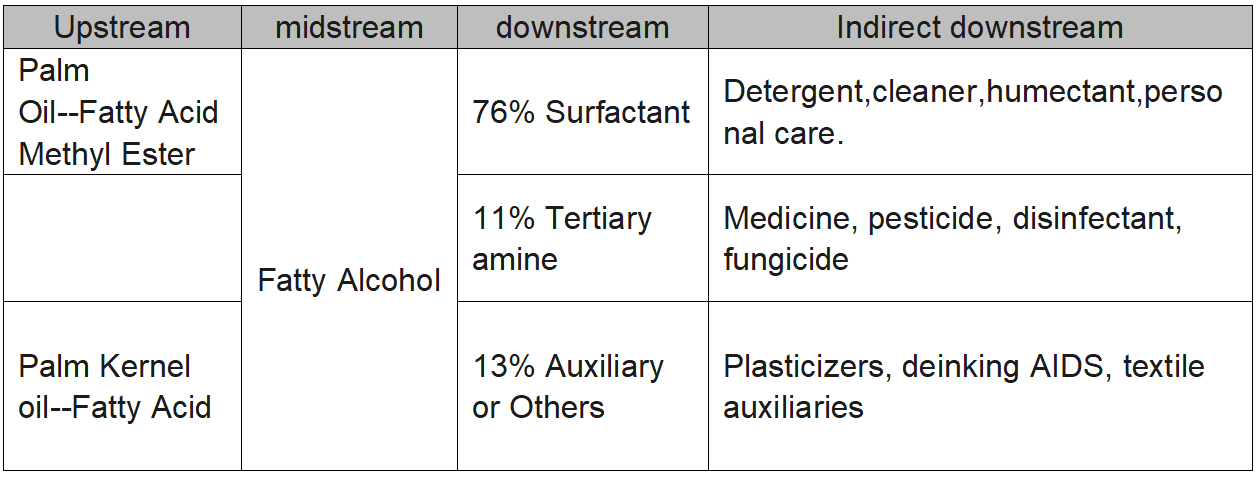
- The upstream and downstream structure diagram of the fatty alcohol industry chain.
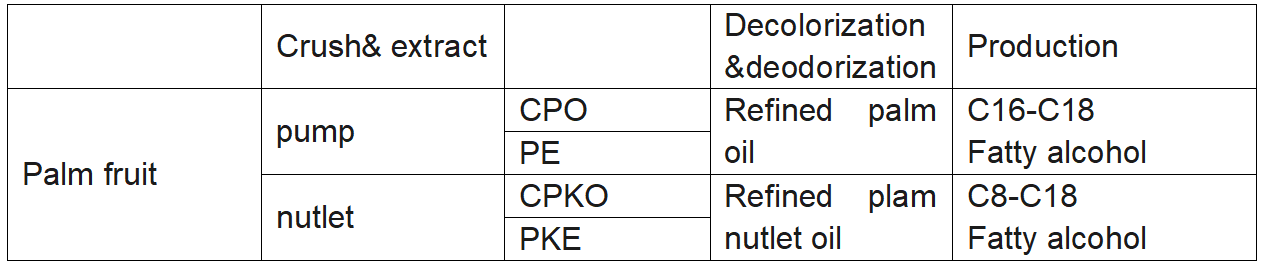
- The production process and carbon chain component composition of palm oil
- Analysis of fatty alcohol market in 2025
3.1 Analysis of the current operating situation of the fatty alcohol industry in a changing supply and demand environment.
- The global palm kernel oil production areas are mainly distributed in Southeast Asia. Indonesia and Malaysia account for more than 85% of the global total output.
- Indonesia is the world's largest palm kernel oil planting area, with an average annual output of about 4.42 million tons. Malaysia, as the world's second-largest palm kernel oil planting area, has an average annual output of 2.11 million tons
- In 2024, the output of palm kernel oil declined significantly due to extreme weather conditions such as El Nino. Taking Indonesia as an example, the output in 2024 decreased by 12.6% year-on-year
- Over the past three years, the output of palm kernel oil in Malaysia has increased significantly during the peak season, but has been declining year by year during the peak season. In the past two years, due to the influence of rainy weather, drought, and aging trees, the growth of crops has been affected to some extent, the growth rate of output has slowed down, and in some areas, it has decreased, leading to a tightening of supply.
- Inventory data has been declining month by month since the second half of 2024. One reason for this is the sharp contraction in the supply of cocoa, a related product, with kernel oil replenishing cocoa. Second, under the background of climate influence and seasonal production cuts, it is difficult to restore inventory.
- The global capacity of fatty alcohols is mainly concentrated in Southeast Asia. Indonesia and Malaysia have the geographical and cost advantages of being close to the main raw material production areas and are the main producers of fatty alcohols.
- Over the past five years, the newly added production capacity was only 40,000 tons, mainly due to the fact that all raw materials had to be imported, resulting in a low cost advantage.
- The five-year review growth rate of nonionic surface activity was 5.3%, the demand in the downstream market has increased significantly 33.6%.
3.2 Analysis of the operating rules and influencing factors of fatty alcohol prices.
- The price of fatty alcohols fluctuated significantly during the period from 2020 to 2024. The policies of the main raw material production areas in Southeast Asia, weather conditions, and supply were the main reasons for the price changes.
- From the perspective of cost and profit, in 2024, the cost and price of fatty alcohols will be closely related, resulting in a narrow profit margin. The biggest impact point on the cost of fatty alcohols lies in the fluctuation of raw material palm kernel oil. The downward transmission of raw materials is relatively sensitive and directly affects the price trend. In 2024, the profits of the mainstream fatty alcohol processes were all in a negative profit state. The annual theoretical profit value of fatty alcohols is -440 yuan per ton, and the lowest point of the monthly average theoretical profit of fatty alcohols has even reached a low of -1532 yuan per ton.
- From 2020 to 2024, fatty alcohols and their downstream major varieties successively entered a period of rapid development at different times. Although the industry scales and development speeds vary, the price fluctuation patterns of fatty alcohols and their upstream and downstream products tend to be consistent, and the price fluctuations are close to the trend of raw materials. Among the upstream products, there is a significant correlation between fatty alcohols and palm kernel oil. In the downstream products, there is a change in the correlation between downstream nonionic surfactant and fatty alcohols.
- From a long-term perspective, the supply situation of raw materials produced locally from 2020 to 2024 remains the primary influencing factor for the price fluctuations of fatty alcohols. In 2022, the short-term imbalance between supply and demand led to a significant increase in the price of fatty alcohols. After 2023, as the demand for fatty alcohols recovered slowly, their prices remained at a relatively low level. However, in 2024, the shortage of raw materials such as kernel oil and fatty alcohols once again pushed up the prices of fatty alcohols significantly.
- Continuing the tight supply situation in 2024, with the inventory of kernel oil at a three-year low, coupled with factors such as insect disasters, heavy rain, and Ramadan, the production and inventory of kernel oil are difficult to recover, raising concerns among industry players about the future market of kernel oil. The oil price has broken through a new high in nearly three years, and the pressure of high costs has continuously pushed up the price of fatty alcohols, driving up the downstream industrial chain in parallel.
3.3 Predicted development trends for the fatty alcohol industry in 2025.
- In 2025, China will have a new set of fatty alcohol facilities. The annual and monthly production capacity of fatty alcohols is expected to show a trend of being low in the first half and high in the second half, increasing month by month. It is estimated that the monthly output of fatty alcohols in 2025 will be around 39,000 tons, and the total annual output is expected to be around 497,000 tons.
- The low point of production in 2025 is expected to occur between May and July, as the current stage is in the traditional off-season of the industry and factory maintenance is relatively concentrated. The peak of production in 2025 is expected to occur in the second half of the year. The period from August to October in the second half of the year is the traditional peak season for the industry, with enterprises operating at full capacity. Coupled with the planned commissioning of domestic fatty alcohol facilities in the second half of the year, the production in the second half of the year will increase significantly compared to the same period in 2024.
- Looking at 2025, the tight supply situation of raw material palm kernel oil will intensify compared to 2024. The price of fatty alcohols will closely follow the trend of kernel oil, thereby forming a corresponding price drive. In 2025, due to factors such as reduced production, pest outbreaks, and heavy rain in the production areas, the supply will decline significantly. The expected recovery of kernel oil production and inventory is expected to be slow, raising concerns among industry players about the future supply of kernel oil. It is predicted that the average annual price of fatty alcohols will remain at a relatively high level in 2025.
The US has halted the export of ethane to China. Could raw material prices soar again?
Trend of ethylene oxide (EO) industry in 2025
